
After Baku, Before Belem: Tasneem Essop on Why Climate Finance Is about Justice
- Jiang Yifan
- Aug 5, 2025
- 17 min read
Updated: Nov 9, 2025

This is an abridged version of the interview first published in Chinese in Initium Media on April 7, 2025. The full interview in English can be found here in the substack Crunch Times.
Editor’s Note
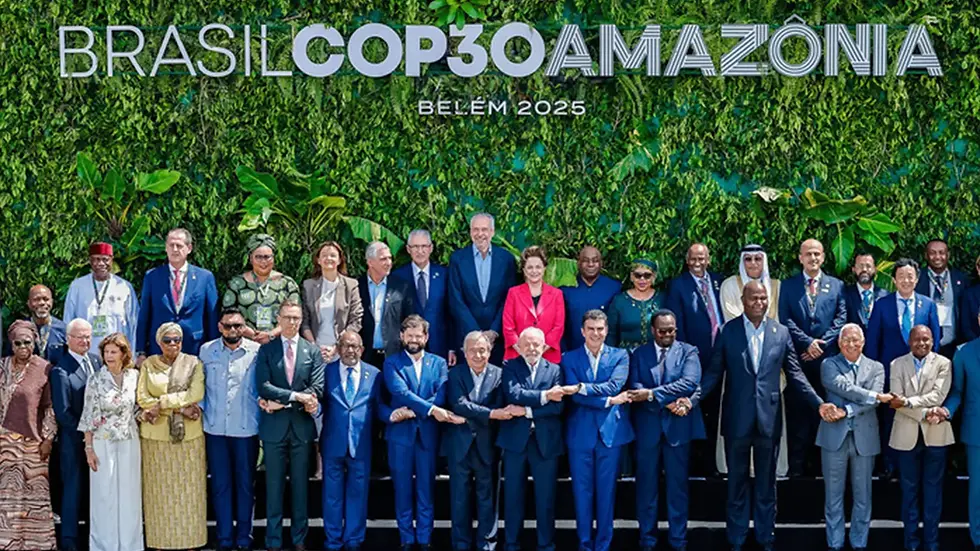
This interview with Tasneem Essop, Executive Director of Climate Action Network (CAN) International, was conducted by Chinese journalist JIANG Yifan in late January 2025, just after COP29 ended in Baku. As countries prepare for COP30 in Belém, Brazil, CarbonCopy is publishing it now because it offers a frank perspective on the political undercurrents that shaped the outcome of last year’s summit, and the deep frustration many Global South actors are bringing with them into the next round of climate negotiations.
The expectation at COP29 was to deliver a new, ambitious climate finance target post 2025. Civil society coalitions, including CAN International, had a clear demand. They wanted rich countries to provide $5 trillion annually in public finance to support climate action in developing countries. Instead, COP29 delivered a far more modest figure of $300 billion per year, to be reached only by 2035. For those in the Global South, this outcome fell well short of what is needed. It also reinforced a long-standing pattern of unfulfilled commitments from developed nations.
Essop’s views go beyond the headline figures. She gives a detailed account of how the negotiation process in Baku, which was marked by a lack of transparency, closed-door discussions, and a last-minute decision, pushed through without consensus. How it damaged trust and highlighted the structural imbalance that continues to define international climate diplomacy. She also discusses the broader shifts taking place within the global climate movement.
The threat to multilateralism is growing, and so is the gap between rich and poor countries. This conversation provides crucial context to how political power and influence are responding to climate impacts. It explains the disappointment that many developing countries and civil society groups felt in Baku, and the growing resolve not to accept incrementalism in Belém.
As COP30 approaches, this interview serves as a window into the evolving politics of climate action shaped by history, sharpened by inequality, and increasingly driven by demands for justice, not just in climate outcomes, but in how those outcomes are negotiated.
First, I’d like to ask you about your reflection on COP29. I know it’s a very multifaceted and very complex issue, but what are the biggest takeaways and the lessons from the experience?
The civil society movement including CAN was extremely disappointed with the outcome, especially on finance. This was our big fight for the year. This was a finance COP. We wanted to see a much more ambitious outcome. Especially recognising that the Global North for a very, very long time, was reluctant to take that responsibility under the UN Convention on Climate Change and the Paris Agreement to provide finance to the Global South.
As civil society, we went into this COP with a clear expectation that we should now finally get an ambitious outcome on climate finance, and a goal that is reflective of the needs and the reality on the ground in terms of what we would require to take climate action in the Global South. You know, the previous goal of $100 billion wasn’t based on any calculation of the need. And in turn, the Global North did not actually deliver the $100 billion. There’s been all kinds of accounting attempts to say they delivered, but the very definition of climate finance has not been resolved.
So, we, as civil society, largely in a big coalition, through the year, put the pressure on governments to at least deliver $5 trillion of public finance per year from 2025 to 2030, as only part of the climate debt that the Global North owes the Global South.
If you look at the needs and the different studies of what that means, $5 trillion isn’t actually ambitious. And others are saying we’re going to need more. But we, compared to where governments were at the time, wanted to put forward an ambitious number so that hopefully that would have pushed for more ambition amongst especially our global south governments, whose highest proposed amount on the table at that time, I think was from India, around $1 trillion. And even that included private finance, not just public finance. So we really wanted to centre the demand for public finance. The tactic here was to put forward a higher number so that we can pull up the level of ambition going into Baku.
And we did work with governments as well. Before we went to Baku, we particularly engaged with the Africa Group and the LDCs, etc. So that they can also get a bit more ambitious in what their expectations were.
The Global North did not put a number on the table until the very last moments of the negotiation. Of course, if people are negotiating and there’s no transparency about what the other parties are offering, that just firstly breaks down trust. Secondly, you don’t know what you’re working with. You can’t negotiate if there isn’t anything firm on the table. So I think that way of conducting a negotiation wasn’t one in good faith, and that disadvantaged developing countries.
It was clear when the first numbers came out, it was $250 billion [only to be reached by 2035]. The Global South reacted with complete outrage. We were outraged, too. And so that was the point at which civil society groups stood very firmly and said, “No deal is better than a bad deal”, and rather come back at this for the next COP.
And we engaged with the Global South, the G77+China (a bloc of 134 developing countries in the United Nations) and the different blocks in the G77 just to test that, would they be able to stand behind that. They were super angry about all of this.
But, with the dynamics of negotiations and the pressure generally, we understood that our Global South governments did not want a failure in a multilateral process, they really wanted to maintain the faith in multilateralism, because that is the only real space where the Global South has a voice. Maybe not equal power, but equal voice in the system.
So, yeah, that’s where we got to. “No deal is better than a bad deal” wasn’t something that materialised and they accepted that weak outcome.
Did the election of Trump play a role in the weak deal finally accepted by the developing countries because they thought that next year in Brazil there would be an even smaller chance for a deal to be struck?
That was the kind of justification from the Global North about why they couldn’t put more on the table. All their own domestic politics like the cost of living issues in Europe, the rise of the right wing, and the threat of Trump were used—”listen, take this or else it’s going to be worse” kind of thing. This was their messaging and narratives for why they can’t do any better in terms of their ambition.
In the end, governments make up their own minds about what they are willing to compromise on. As civil society, we were very disappointed with the outcome. But now that the decision is made, some countries have raised their objections and concerns in the plenary, but are they going to follow through with formal objections? So we don’t know where that stands. I doubt whether that will happen. I think people have now just accepted that.
But then there was a very concerning knock-on effect of such a weak outcome on finance, other areas of negotiation were sacrificed as well. So you would know the Just Transition Work Program, which is a very critical area in the negotiations and the negotiators had made progress on, was sacrificed and deferred to the next COP. Of course, the Mitigation Work Program (Note: In UN vocabulary, “mitigation” means emissions reduction and sequestration.) was always held hostage by outcomes on finance.
And then there is the process itself. I’ve been to too many COPs in my lifetime, including Copenhagen, which was already a really bad experience. But Baku’s process was unbelievable.
You would know that the negotiations just mainly went behind closed doors. The presidency convened bi-laterals or meetings with blocs, etc. And they all happened behind closed doors, in fact, in the presidency suite. And civil society did not have sight of what’s going on. It wasn’t transparent.
How did we get to the decision? What was traded off? Who were the ones that were blocking? You have to get information about what’s happening behind closed doors, so that we get a sense of things and we are able to respond. But then the presidency just gaveled through the decision. It was very shocking.
So I think that it was not just the outcome of the negotiations, but the process at this COP that was also seriously worrying. And we certainly don’t want to see that as setting a precedent for any future COPs.
So, do you think the UN climate regime is in need of reform, as what was called for during the COP?
There are areas that would require reforms, not just because of Baku, but for all our experience over the years.
One of them is the role of civil society in these spaces and what meaningful and inclusive participation of civil society looks like. I’ll give you a practical example.
Obviously, we’re not involved in negotiations, and I don’t think the UN system and governments are ready for that level of inclusivity, but when we are called upon to speak at the plenaries, we literally get only two minutes per Observer constituency.
This is the same for the environmental NGO (ENGO) constituency. We are one of two focal points for ENGOs, and we have a sister focal point which is DCJ [Global Campaign to Demand Climate Justice]. Because of that, the two minutes have to be shared. So, here you have two very big global networks literally having one minute each to articulate their views in a UNFCCC process.
And then, other participation, say when contact groups meet etc, it is up to the chair to decide whether we can speak or not. And to a large extent, if one party objects, we can’t speak. So, our participation there is not really meaningful. And that is why we’ve chosen to have a voice outside of the rooms.
That’s why you would see us putting that pressure on negotiations using the only other method that we can use and that is our action. Peaceful demonstrations outside the meeting rooms raising our voice and pushing negotiators to raise ambition.
The process in the UNFCCC has to be transformed in a way that gives us much more meaningful opportunities to participate. So, yes, I would say for civil society that’s one of the areas that we need to transform the UNFCCC.
I think a second area of transformation would need to be this: you can’t leave the decision on how negotiations need to be conducted to individual COP Presidencies themselves. There has to be some kind of basic guidelines that all COP Presidencies must follow.
But currently we’ve seen that from one COP President to another COP President the approaches to the process are different. It’s too risky to do that.
Because of the particular way the UN climate regime makes decisions, which is called “consensus decision-making” in which there is no operational definition of what a consensus is, the presidency enjoys ample freedom to use the gavel. And some scholars are now arguing that there needs to be some degree of voting in making decisions at COPs, to constrain the presidency. What do you think of this kind of suggestion?
There’s one step before that. This is a party-driven process, so the presidency should not be driving the process in the way Baku did. We can’t have a presidency deciding what a party-driven process should look like.
The second one is this issue of consensus. It only takes one party to just object, and there’s no consensus. So you’re right, the rules of consensus have to be clearer.
And on the point of voting, I don’t know if it’s still on the agenda, but there used to be a standing agenda item put forward by Mexico on voting.
Especially when things are getting tougher and tougher in the multilateral space, maybe clearing up some of these operational rules would be really helpful, in a space deeply affected by geopolitics, where the levels of trust have diminished over the years. In such a context, I think the rules need to be clarified, and also the role of presidencies and what they can and cannot do.
There’s a host agreement signed between the UNFCCC and the presidencies, those host agreements should be looked at and reviewed and see whether it should be tightened up.
So I think there’s always room for strengthening and improving with the aim to become far more inclusive, far more transparent across the board and also, of course, to become effective. We don’t have time for this kind of slow pace with which this process is delivering results.
Could you envision the road ahead for global climate movement and climate diplomacy, considering what’s currently going on in the US and in Western democracies, with the rise of the far-right politics and oligarchy, etc.?
Look, the kind of power of oligarchies have always been there. What is happening now is, of course, they’re consolidating power and it’s becoming much more visible to us. It’s expanding that power and it is being bolstered by this emerging rise of right-wing politics across the board in the US, in Europe, but in other places in the world, even in the Global South.
So in such a context, for us, if the US and if other Global North countries take similar paths, I believe that we really have to look at the South-South collaboration much more strongly.
We probably need to reflect on the fact that for many years, and of course this comes out of the legacies of colonialism etc., the Global North has built this economic dependency on itself of the Global South. Meanwhile, we’ve also experienced, especially in the climate crisis space, that the Global North has put no real commitment to helping the Global South.
In such a context, I think the message is pretty clear. The Global North will never have the interest of the Global South at the front of their minds. They just haven’t proven that there’s a real track record around that.
Let me use another example.
During COVID, what did the Global North do? They went inward, they took care of themselves. They were not even willing to provide Global South countries with much needed vaccines. They weren’t even willing to share the intellectual property of their vaccines.
They’ve built close relationships with certain blocs for their self-interest. In the climate space, they’ve often tried to play divide and rule tactics with the G77+China bloc—for all the differences and challenges within the bloc—so that they have their interests protected.
The one thing that we know is that if the G77+China stands strong and united, you actually make progress. And the Loss and Damage fund is just one example of that. But it’s sad that the G77+China has not had many examples where they have stood united. There have always been breakaways.
So to what extent has divide and rule tactics actually worked in breaking down the unity of the G77 when they need to be united on some of the key issues? For me, looking forward, understanding that will have a huge impact when the US withdraws [from the Paris Agreement] like they’re doing now.
I think this is where now as the Global South—not only governments, but also civil society—we need to look at to start strengthening our solidarity, our collaboration, our independence in relation to the Global North. How do we start lessening our dependence? How do we start unraveling the apron strings to the North? If we were not so in debt, if we had sovereignty of decision-making, if there wasn’t all this interference when our resources are being extracted and going to the Global North, if we add sovereignty over all of the critical minerals and other resources, we could very much stand on our own two feet.
So, I think that it is time for us to look at the South-South collaboration much more strongly.



Comments